
⏱ 14 min read
Cataract Surgery Cost
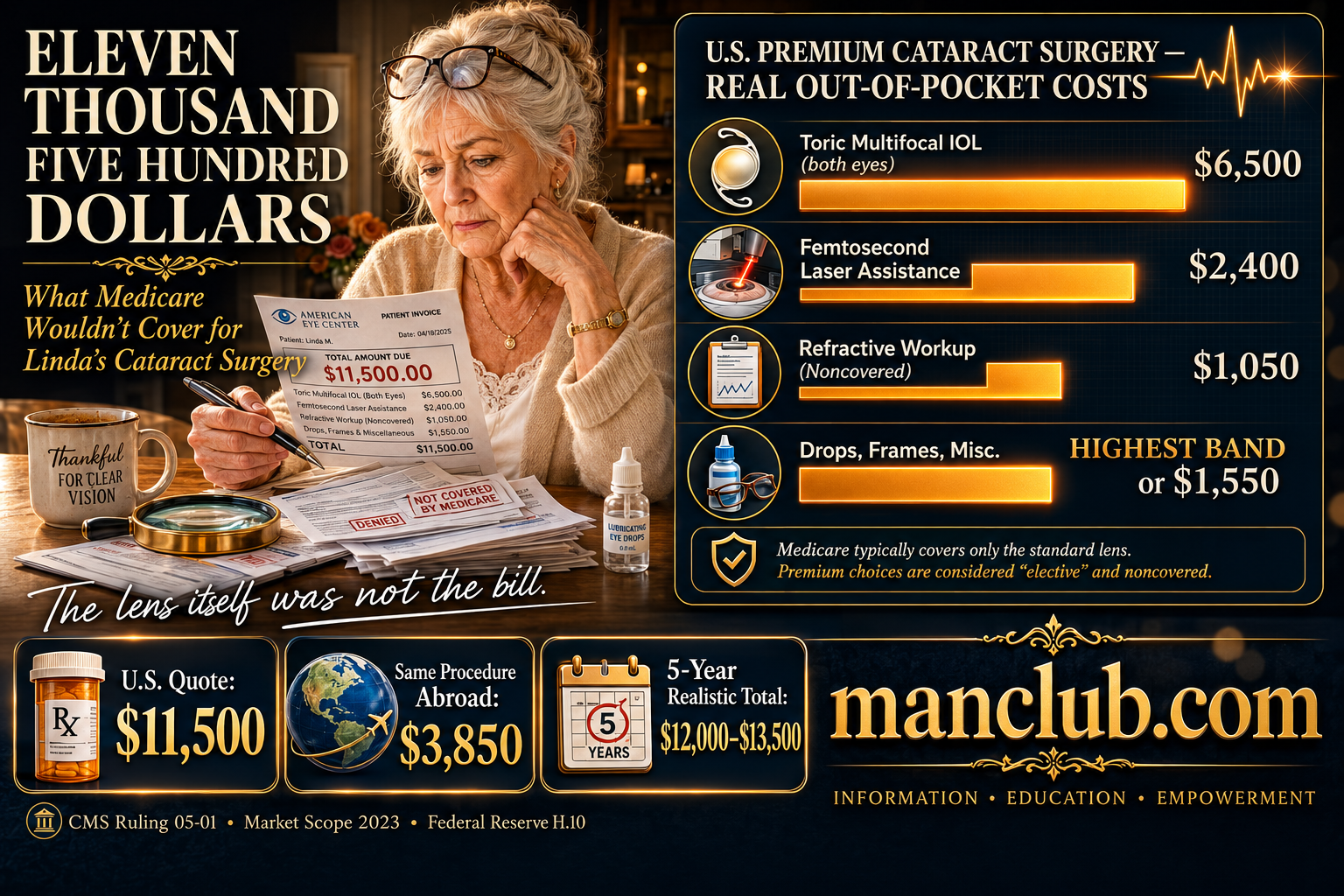
The American cataract surgery cost conversation doesn’t happen in one place or at one price — and for patients on Medicare who want a premium lens, the gap between the quoted number and the real out-of-pocket number can be thousands of dollars wide.
Linda stopped driving at night first. Then she stopped reading newspapers…
Sophia was eleven and tall for her age, three aisles down at the Kroger in Brentwood, in her middle school uniform. She called “Grandma” twice before Linda’s face changed. Everything about the girl — her features, her bright pink cardigan, the hand waving at shoulder height — looked like a watercolor that had been left in the rain.
By the time Linda got back to her small house in Franklin, Tennessee, she had made an appointment with an eye doctor. By the time the appointment came up six weeks later, she had stopped cooking dinners that required her to read labels.
Linda was 72 years old. Widowed for five years. Forty years into her American life — she had come to Nashville from Seoul at 32, built a small laundry business in Franklin with her husband, raised two sons. She was an American citizen. She was a Medicare beneficiary. And she was about to learn what that meant, and didn’t mean, when a common surgery came with a premium option stacked on top of it.
She called her younger son that night.
Daniel was 45, working in IT in Atlanta. He had grown up speaking English at home, gone to public school in Williamson County, and never learned to read Korean past his own name. He picked up on the third ring.
“Something’s wrong with my eyes,” his mother told him in Korean.
*Names and identifying details have been altered. Some elements are composites drawn from multiple comparable cases and published cost data.
The American Path
The American cataract surgery cost conversation, Linda was about to learn, doesn’t happen in one place or at one price.
Linda’s new-patient appointment took roughly five weeks to come up, consistent with the 2025 AMN Healthcare physician access data showing a 31-day average wait for specialist appointments in major U.S. metros.
The ophthalmologist looked into Linda’s eyes for a long time before he spoke.
Bilateral cataracts, moderate-to-advanced. The left eye was slightly worse. Pre-existing corneal astigmatism of 1.75 diopters. Nothing unusual for a woman her age. Nothing that would have been prevented by anything she had or hadn’t done.
He explained the treatment in the way American ophthalmologists explain it: directly.
“The only fix is surgery. Glasses don’t correct cataracts. We remove the cloudy lens and implant an artificial one. That part’s straightforward.”
He paused.
“What isn’t straightforward is the lens choice. Medicare covers a standard monofocal lens. If we put that in, your cataracts are gone but your astigmatism is still there, and so is your near-vision loss. You’d need a pair of distance glasses and a pair of reading glasses afterward. If you want to be rid of glasses entirely, we’d use a Toric Multifocal — a premium IOL that corrects astigmatism and presbyopia at the same time. Medicare doesn’t cover that lens.”
“How much would it be?” Daniel asked, on speakerphone from Atlanta.
“You’d need to come in for a separate refractive consultation for us to give you a real number.”
The Cost of Finding Out
Over the next two weeks, Daniel called three ophthalmology practices around Nashville and asked what a bilateral Toric Multifocal cataract surgery would cost out of pocket for his mother.
Two of them refused to quote a number over the phone. One said it “depended on testing.” All three said the same thing: “You’ll need to come in for a consultation first.”
The consultation at a board-certified cataract specialty clinic in Nashville was $385, not applied toward any procedure cost. The refractive workup required to generate a premium IOL quote — corneal topography, optical biometry, macular OCT — was another $450. Medicare covers none of it. Under CMS Ruling 05-01, all services related to the refractive benefit of a premium IOL — consultation, testing, surgical planning, post-operative refractive exams — are noncovered. Linda had Medicare Part B and a Medigap Plan G. Neither paid a dollar of it.
Before Linda saw a final surgical quote, she had spent $835 finding out what the surgery would cost.
This is not unusual. This is the structure. Patients who want a premium lens pay for the entire refractive workup out of pocket. Patients who don’t want to pay that get a standard lens and two pairs of glasses and are told the system worked.
The Sunday after the refractive consultation, Daniel emailed an eye clinic in Seoul that his mother’s friend Mrs. Park had used two years earlier. By Monday morning he had a PDF in his inbox — the coordinator had laid out expected lens options, package pricing in both won and dollars, and a proposed timeline. The email was free. The in-person consultation, if Linda flew out, would be ₩30,000 — about $20.
The week they spent diagnosing the problem in America cost $835. The process of getting the same information from Korea cost nothing.
The Estimate
Linda’s American treatment plan came back itemized.
The items Medicare and her Medigap covered — standard surgery, anesthesia, facility fees, ninety days of post-operative routine care, one pair of basic glasses — she would pay nothing for. The items Medicare did not cover were a different list.
| U.S. Noncovered Premium Item (Bilateral) | Out-of-Pocket Cost (USD) |
|---|---|
| Toric Multifocal IOL upgrade, both eyes | $6,500 |
| Femtosecond laser-assisted surgery, both eyes | $2,400 |
| Refractive preoperative testing (noncovered) | $600 |
| Surgeon’s refractive services professional fee | $1,400 |
| Post-operative eye drops (antibiotic, anti-inflammatory, lubricating) | $200 |
| Premium frame upgrade | $400 |
| Initial Out-of-Pocket Total | $11,500 |
The number at the bottom of Linda’s plan was a ceiling, not a floor. Cataract surgery in the U.S. generates long-tail costs that keep appearing after the ninety-day global period ends. U.S. Medicare claims data show that about 22% of patients who receive presbyopia-correcting IOLs — the category Linda’s lens falls into — develop posterior capsule opacification within a year severe enough to require a YAG laser capsulotomy. That runs another $300 to $500 per eye. Refractive surprises occur in 12 to 15 percent of cases and, if corrective enhancement is needed, add $1,500 to $3,000 more.
A realistic five-year cataract surgery cost: $12,000–$13,500.
Linda’s is not a rare situation. American medical billing routinely fragments a single decision across a long line of separate charges, and cataract surgery is one of the cleanest examples of how this plays out for an older patient.
What Stopped Her
Linda lived on Social Security and her late husband’s small pension. Last year she had thought about a new washing machine for three months before she bought it. Her husband’s life insurance had gone into the Franklin house and most of it had stayed there.
Daniel said the thing children say. “Mom, I’ll cover it. Get the surgery.”
Linda said the thing mothers say. “Sophia’s college is more important. I’ll live with two pairs of glasses.”
She considered the monofocal option. With a standard lens, she would need progressive lenses to handle both distance and reading — about $500 to $800 per pair in Nashville, replaced every two to three years. From 72 to 90, that added up to $5,000 to $8,000 in glasses alone, and she would still be squinting at labels.
Neither option was cheap. And she still wanted to see her granddaughter’s face clearly.
Three months passed. Her vision got worse. She stopped driving during the day on anything but the most familiar routes. She read the Bible at the dinner table with a magnifying glass.
Two new lenses, two eyes, $11,500 out of pocket. What would you tell your mother?
The Friend of a Friend
It was the Tuesday women’s fellowship at Nashville Korean Presbyterian Church. Three women Linda’s age, sitting at one of the long tables with coffee and rice cakes. Linda told them what the doctor had said, what the quote was, where she was stuck.
Mrs. Park set down her cup.
“Sister, just go to Korea. I did it two years ago. Both eyes, multifocal lenses, everything from surgery through follow-ups. Came out to a little over four million won — under three thousand dollars at the exchange rate back then.”
Linda was quiet. “Korea. It’s been forty years. What’s it like now?”
“Better than here, honestly. The surgeon I used does forty cataracts a week. He speaks English. Don’t worry.”
That was the whole conversation. Mrs. Park texted Daniel the clinic’s contact information that night.
Daniel’s Research
Daniel spent the weekend emailing four eye clinics in Seoul. The one Mrs. Park had used, and three others that advertised heavily in English to international patients. He asked each of them for the same thing: a bilateral cataract surgery with the same specific lens — the Alcon PanOptix Toric, a globally standard presbyopia-correcting IOL, the same lens his mother’s Nashville surgeon had recommended.
The quotes came back:
- Clinic A (Gangnam, “international patient center”): ₩9,000,000
- Clinic B (Gangnam, “international patient center”): ₩7,200,000
- Clinic C (central Seoul, the one Mrs. Park used): ₩5,500,000
- Clinic D (central Seoul, general high-volume practice): ₩4,800,000
Same lens. Same manufacturer. Nearly double the price at the top end.
Daniel noticed what the expensive ones had in common. English-first websites. Airport pickup. International patient coordinators. The two cheaper clinics had Korean-first websites, replied in English competently, and simply didn’t market themselves to foreign patients. According to the Korea Medical Tourism Association, agencies and dedicated international patient centers typically add a 10 to 15 percent coordination fee on top of standard clinic pricing. The gap between Daniel’s quotes was bigger than that, but the direction was the same.
“Let’s just go to the one Mrs. Park used, Mom.”
Daniel booked Clinic C. Surgery was scheduled for the week after Linda would arrive in Seoul. He took two weeks off. He couldn’t read Korean street signs, but the surgeon spoke English and his mother was 72 years old and he wasn’t putting her on a plane alone.
Linda made the decision in the spring of last year. The exchange rate at the time was around ₩1,430 to the dollar.
The Korean Path — Twelve Days in Seoul
Linda brought nothing with her from Tennessee — no prior imaging, no records. The Seoul clinic had asked for none.
Day 1. Arrive at Incheon. Linda and Daniel stayed at a hotel near the airport the first night to let her sleep off the flight.
Day 2. Into Seoul. That afternoon Linda met a distant cousin she hadn’t seen in thirty years. Over coffee, the cousin asked why she had come. Linda explained.
“An eye clinic? There are too many good ones to recommend one. Just check reviews, pick a place that’s busy. The busy ones are all fine. It’s routine here now. Honestly, Korean clinics are all pretty good.”
Day 3. Arrival at the clinic. The morning was full diagnostic workup — biometry, corneal topography, macular OCT, endothelial cell count, IOL power calculation. Ninety minutes. The surgeon reviewed the results in the afternoon, examined Linda’s eyes directly, and spoke in English.
“Left eye first. Tomorrow afternoon, if that works for you.”
Linda turned to Daniel. “Tomorrow?”
The surgeon answered before Daniel could. “Fifteen-minute procedure. Next day, we check. Three days after that, we do the right eye.”
Day 4. Left eye surgery. Femtosecond laser-assisted phacoemulsification, Toric Multifocal IOL implantation. Fifteen minutes. In the taxi back to the hotel, Linda said out loud that she could read the storefront signs out the window. That night, in bed, she read her phone screen clearly in a dark room for the first time in more than a year.
Day 5. Follow-up. Vision stable. No pain.
Day 7. Right eye surgery.
Days 8–10. Recovery. Linda read a book — a whole book. She wrote Sophia a letter in English from the hotel writing desk.
Day 11. Final follow-up. The surgeon handed Linda an English-language clinical summary and a copy of her Korean imaging.
“You’re done. If something feels off, see a U.S. ophthalmologist. Otherwise you don’t need to come back.”
Day 12. Flight home through LAX to Nashville.
What Linda Paid
The clinic’s invoice was in won, and it had almost no line items, because almost everything was bundled.
| Bilateral Package Item (Seoul Clinic C) | Price Structure (KRW) |
|---|---|
| Full diagnostic workup (biometry, topography, OCT, endothelial count) | Included |
| Femtosecond laser-assisted phacoemulsification & Alcon PanOptix Toric IOL × 2 | Included |
| Topical anesthesia, light sedation, and post-op medicated eye drops | Included |
| Three comprehensive post-operative follow-up visits | Included |
| Total Foreign Out-of-Pocket Cash Pay | ₩5,500,000 (~$3,850 USD) |
At the ₩1,430/$ rate in effect the week of the surgery, that invoice came to roughly $3,850.
Her American quote had been $11,500 before the five-year long-tail costs started. The Korean invoice covered the same lens, the same laser, the same diagnostic battery, and three follow-up visits — all for about a third of the U.S. out-of-pocket price.
A note on Korean insurance: local residents in Korea typically carry supplemental private health insurance at roughly $50 per month, which absorbs much of the out-of-pocket cost for premium IOLs. Linda, as a U.S. citizen paying cash, didn’t qualify for any of that. She paid the full market rate a Korean patient would pay without private insurance.
The Question Behind Linda’s Decision
A careful reader, at this point, is probably thinking the same thing about Linda’s story that they thought about Dave’s first trip: the numbers look clean, but is this actually a sound decision, or did she get lucky?
Four ways to look at it.
1. Is American cataract pricing actually this expensive, or is something being left out?
American cataract surgery cost structure is genuinely this expensive, and what’s being left out is usually more charges.
- Medicare covers only the conventional (monofocal) IOL. CMS Ruling 05-01 (2005) and the follow-up 2007 ruling on toric lenses classify all services tied to the refractive benefit of a premium IOL as noncovered. That includes the lens upgrade itself, the preoperative refractive testing, femtosecond laser assistance, intraoperative aberrometry, and any post-operative exams specifically related to the refractive outcome.
- Industry tracking from Market Scope suggests only 15 to 18 percent of U.S. cataract patients opt for a premium IOL, largely because of cost. A 2019 Ophthalmology paper found patient willingness drops sharply once the out-of-pocket cost crosses about $3,000 per eye.
- American pricing is structurally fragmented. Linda’s U.S. estimate had six separately billed items. Her Korean invoice had one.
A 72-year-old on Medicare who blinks at $11,500 isn’t an outlier. She’s near the middle of the distribution.
2. Is Korean cataract surgery actually good, or just cheap?
The volume and outcome data don’t support “just cheap.”
| Clinical Metric | 🇰🇷 South Korea | 🇺🇸 United States |
|---|---|---|
| Annual Cataract Surgeries | ~650,000 (2020) | ~4,000,000 |
| Surgeries per 1,000 Population | 12.6 | 12.0 |
| Avg. Surgeries per Surgeon per Year | ~372 | ~400 |
| Endophthalmitis (Major Infection) Rate | 0.063% | 0.04%–0.10% |
Sources: Kim et al., Yonsei Medical Journal, 2019; Korean Society of Cataract and Refractive Surgery Survey 2020; American Academy of Ophthalmology; U.S. Medicare claims analysis.
The Swedish National Cataract Register data the AAO cites on volume and outcomes shows complication rates dropping as per-surgeon case volume rises: 2.15% for low-volume surgeons, 1.32% for medium-volume, 0.59% for high-volume (500+ per year), 0.48% for very high-volume (1,000+). The average American and the average Korean cataract surgeon are both firmly in the medium-to-high volume band. On experience alone, the two countries are statistically indistinguishable.
Linda’s cousin in Seoul said it plainly over coffee: in Korea, finding a specifically great cataract surgeon is almost a meaningless search, because it’s too routine to differentiate. Just pick a busy one.
3. If something goes wrong, what’s the safety structure?
Korea is not a medical tourism gray zone.
- The Korean Ministry of Health and Welfare maintains an official registry of clinics authorized to treat international patients. Unregistered clinics face criminal penalties for treating foreign patients. Since 2016, registered clinics have been required to carry medical malpractice insurance.
- Korea operates a government-run medical dispute mediation body (K-MEDI) that accepts cases from foreign patients treated in Korea.
- According to the Ministry of Health and Welfare, approximately 1.17 million foreign patients from 202 countries sought medical care in Korea in 2024.
None of this guarantees a clean surgery. But “there’s a structure” and “there isn’t a structure” are different starting points.
4. If Korean cataract surgery is this good and this affordable, why isn’t everyone going?
Six real barriers. None of them about quality.
- Information. Most Americans have never considered Korea a medical option. Without Mrs. Park, Linda wouldn’t have either.
- Time. Twelve days away from work is out of reach for many.
- Psychological inertia. Surgery in a foreign country triggers a reflexive no before the math gets done.
- Follow-up continuity. Some U.S. ophthalmologists are reluctant to take over post-operative care on a procedure they didn’t perform.
- Language. Korean cataract surgeons routinely speak English, and major clinics have years of experience with foreign patients.
- The foreigner-tourism premium. English-language marketing in Korea tends to come from international patient centers and medical tourism agencies, which per Korea Medical Tourism Association data add a 10 to 15 percent coordination fee on top of standard clinic pricing. The English-language pipeline isn’t Korea’s best-value pipeline — it’s just the most accessible one. Patients who reach regular Korean clinics through personal networks — Korean-American friends, family, church connections — tend to pay less and access higher-volume practices. The gap is about information asymmetry, not clinical quality.
The barriers are about friction. They’re not about outcomes.
After the Trip
Linda has now been home for about a year.
She drives at night again. She reads the newspaper every morning without a magnifying glass. She went back to Wednesday Bible study at the church. She flew alone to Atlanta for Thanksgiving at Daniel’s.
Six months after the surgery, she went in for a check-up with a Nashville ophthalmologist. He looked at the work and asked, “Where did you have this done? These results are good.”
Three other women from her church’s Tuesday fellowship have since called Linda with questions. One of them had already priced a flight to Seoul before the second call.
Linda’s long-term outcome is not yet known. Exchange rates will keep moving. Korean clinic prices will eventually rise. This is one woman’s decision at one point in time, recorded while the decision was still recent enough to remember clearly.
A Note From the Author
Linda is one case. Her answer was Korea. Yours might be different.
Case #1, Dave’s $12,500 dental story, was a 44-year-old uninsured office worker in Dallas. Case #2, Linda’s, is a 72-year-old Medicare beneficiary in Nashville. Neither of them set out to do medical tourism. Neither of them shopped across five countries. Both of them tried to get care in America first, got a number they couldn’t absorb, had a Korean friend mention an alternative, and followed the friend’s thread to a clinic in Seoul.
Case Files #2 looks at cataract surgery cost the same way Case #1 looked at dental cost — one person’s decision, made in one moment, recorded as honestly as we can write it. Each file is one decision, made by one person, written down as honestly as we can write it.
A pattern keeps showing up, though. In both cases, the decisive moment was the appearance of a Korean friend in the network. For Dave it was Mike’s old Army buddy Ray, long settled in Seoul. For Linda it was Mrs. Park at the Tuesday fellowship. Without that connection, both of them would almost certainly have made different choices in America.
Do you have a Korean friend or a Korean-American family in your life? For decisions of this kind — where the biggest gap between the U.S. and Korea isn’t quality but information access — you’re lucky. That connection tends to route people past the English-language medical tourism pipeline and into the regular clinics where Koreans actually go, at prices Koreans actually pay.
If you don’t have one, this archive may be a starting point. Or it may not. Every person’s situation at this stage of life is different.
The next case is already being written.
Check Your Health Metrics (ManClub Health Tools):
Body Truth Indicator ·
Testosterone Symptom Checker ·
Heart Age Calculator ·
Fitness Age Tool ·
Sleep Age Tracker ·
Burnout Self-Assessment ·
Life Expectancy Calculator ·
Blood Work Decoder
Names and identifying details in this case have been altered to protect privacy. Some elements are composites drawn from multiple comparable cases and published cost data. This content is for informational purposes only and does not constitute medical, legal, or financial advice. No provider-patient relationship is created by reading this article. International medical care involves considerations including travel risk, post-operative care continuity, legal jurisdiction differences, and complications coverage. Weigh these factors carefully and consult qualified licensed professionals in your jurisdiction before making any medical decision.
Thanks for reading. Take care of yourself — nobody else will do it for you.

Wilbur P is the editor of Manclub, leading coverage across health and life. His work is research-driven and built on primary sources a reader can verify – written for men in the second half of life who would rather know than believe. Based in Florida, still learning and still in the fight. Corrections, questions, story tips: [email protected].