
⏱ 14 min read
Hospital 366 Days · Case No. 24
The hospital’s year does not end at 365. It runs to 366, and keeps going.
Call her Bess. Age, occupation, location, and any potentially identifying details have been changed. The clinical pattern is a composite reconstructed from cases emergency rooms see repeatedly, and it does not represent any specific patient.
MASLD cirrhosis can sit quietly in a body that feels completely fine, and that is exactly how it went for Bess. She was driving through midtown when the phone rang.
It was a bright morning. Live oaks two and a half centuries old leaned over the road, Spanish moss hanging from their branches, closing over the street like a roof. The old houses still wore their Mardi Gras colors, purple, green, and gold. She had lived here her whole life. She was thinking about nothing much.
The call was from her doctor’s office. A nurse. Go to the emergency room now, she said. Last week’s blood work looked very wrong. You may need a transfusion today.
It caught Bess completely off guard. A transfusion? She felt nothing. No dizziness, no tiredness, not one sign that anything was off. She was 61 and, as far as her own body could tell her, perfectly fine.
And then, of all things, she thought of Bill. The man who had asked her to dinner not long ago, who had told her she looked so healthy, so full of life. She had let herself picture a future. Now a nurse was telling her that half of something was gone, and she had never felt it leave.
MASLD Cirrhosis Found With No Warning At All
Here is the sequence as the hospital saw it.
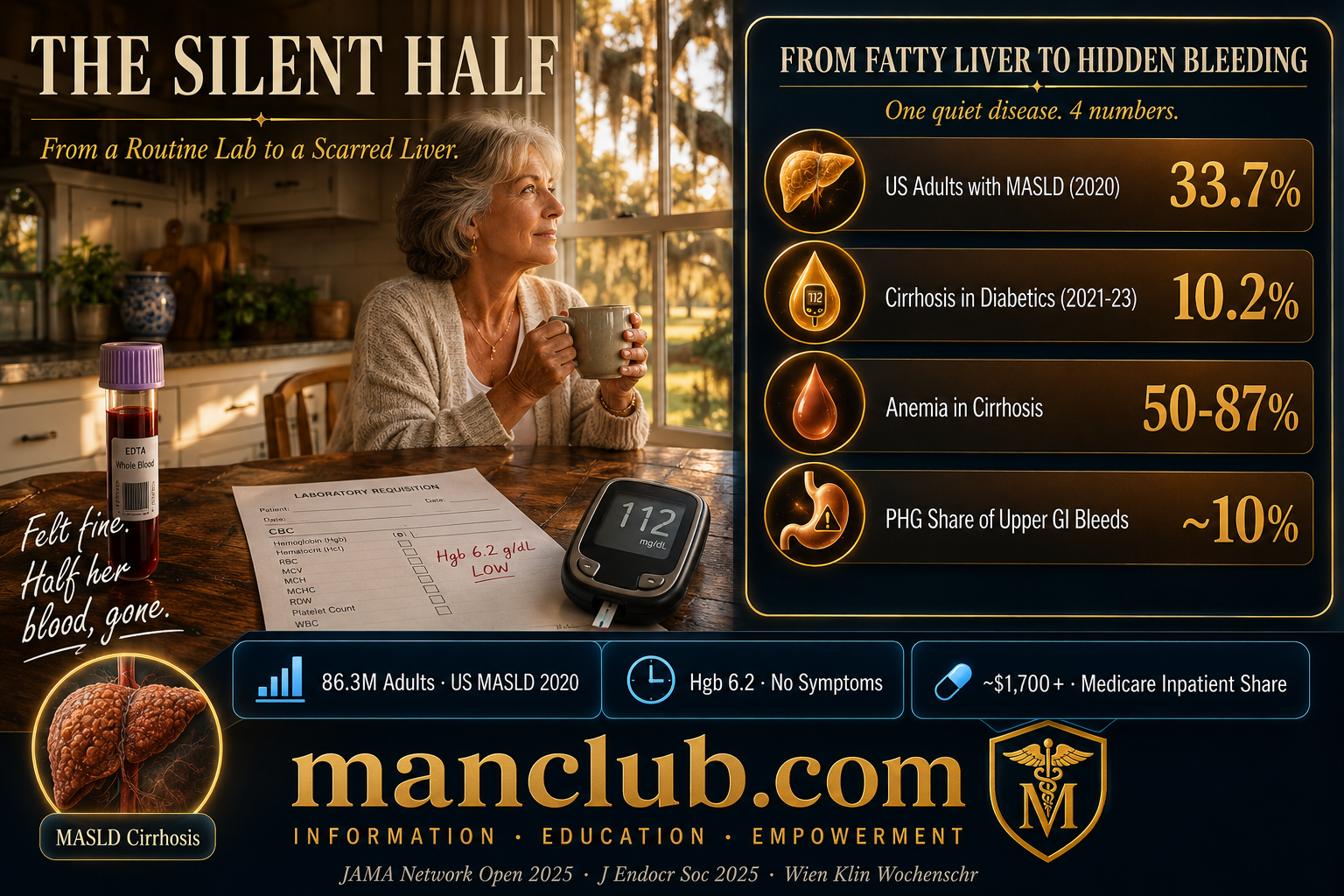
The trigger: A routine blood draw the Monday before. Hemoglobin 6.2, less than half of normal. Her doctor read it and called her in that same day.
On repeat in the ED: Hemoglobin 6.9. Sodium 133. Glucose 106. AST 60. An echocardiogram put her ejection fraction at 57%, a normal pump.
Her history: Chronic back pain. Insulin-dependent type 2 diabetes. High blood pressure. High cholesterol. And, from a few years back, cirrhosis from metabolic dysfunction–associated steatotic liver disease. She does not drink. She has never smoked.
What she denied: No black or bloody stools. No vomiting of blood. No heavy vaginal bleeding. A colonoscopy five years earlier had come back clean. There was no visible place the blood had gone.
| Marker | This Case | Why It Draws Attention |
|---|---|---|
| Hemoglobin | 6.2 → 6.9 | Less than half of normal; the striking part is that it turned up with no symptoms at all. |
| AST | 60 | Only mildly up; a liver marker, but it does not show how far the cirrhosis has gone. |
| Sodium | 133 | A little low, which is common in advanced liver disease. |
| Glucose | 106 | Near the top edge of normal; steady under her diabetes care. |
| Ejection fraction | 57% | Normal pump function; her heart was not the problem here. |
The disease was silent. So was the bleeding it caused. The only thing that made any noise was one line on a routine lab.
Half her blood was gone, and that morning she had walked into a fish market to buy shrimp. One phone call sent her to the emergency room. That was the right call, and the rest of this explains why.
Why MASLD Cirrhosis Hits People Who Never Drink
Bess had asked the question herself, years back, on the day of the diagnosis. She did not drink. She did not smoke. So how could her liver be scarred?
The answer is that alcohol is not the only thing that scars a liver. Fat does it too. Fat builds up in the liver cells, the fat sets off inflammation, and years of inflammation harden into scar tissue. Once the scar replaces enough of the liver, that is cirrhosis. In someone with diabetes, extra weight, high blood pressure, and high cholesterol, MASLD cirrhosis can build this way over a long time, with nothing to feel along the way.
That is the part worth sitting with. Nothing to feel. The liver disease gave no signal, and neither did the slow loss of blood it set in motion.
Plain-Language Reference
| Term | What It Means in Plain Language |
|---|---|
| MASLD | Metabolic dysfunction–associated steatotic liver disease. Fat buildup in the liver driven by metabolic problems, not alcohol. |
| NAFLD / NASH | The older names for the same disease, retired in 2023 in favor of MASLD and MASH. |
| Cirrhosis | Advanced scarring of the liver that replaces healthy tissue. |
| Compensated cirrhosis | A stage where the liver is scarred but still doing its job, often with no symptoms. |
| Fibrosis | Scar tissue in the liver, staged from F0 (none) to F4 (cirrhosis). |
| Portal hypertension | High pressure in the vein system feeding the liver, caused by scarring. |
| Varices | Swollen veins in the esophagus or stomach that can bleed, sometimes heavily. |
| Portal hypertensive gastropathy (PHG) | A fragile stomach lining under high portal pressure that oozes blood slowly. |
| Hypersplenism | An enlarged spleen that traps and destroys blood cells faster than normal. |
| Hemoglobin | The protein in red blood cells that carries oxygen. A low value means anemia. |
| Iron-deficiency anemia | Anemia from low iron, often caused by slow, ongoing blood loss. |
| Melena | Black, tarry stool, a sign of bleeding higher up in the digestive tract. |
| FIB-4 | A simple score from age, AST, ALT, and platelets that estimates liver scarring risk. |
| AST | A blood marker that can rise with liver injury, but can read normal even in cirrhosis. |
| Upper endoscopy | A scope passed through the mouth to check the esophagus and stomach for a bleeding source. |
From the Reviewer · Eleanor Hayes, M.D.
(A) The new name for fatty liver disease
Before 2023, this went by non-alcoholic fatty liver disease, or NAFLD, with the more aggressive form called NASH. The name is now MASLD, metabolic dysfunction–associated steatotic liver disease, changed to name the cause directly: not alcohol, but metabolic syndrome, meaning diabetes, obesity, high blood pressure, and high cholesterol. It is more common than most people realize. One modeling study estimated that 33.7% of US adults, about 86.3 million people, had MASLD in 2020, and projected a climb to 41.4%, roughly 122 million people, by 2050. (JAMA Network Open modeling study, PMC) In cases like this, the label on the chart is not some rare diagnosis; it is one of the most common chronic liver conditions in the country.
(B) How a non-drinker ends up with cirrhosis
For a patient like this, alcohol is not the cause. Fat collects in the liver cells, that fat drives inflammation, and years of inflammation turn into scar tissue. When scarring replaces enough of the liver, it becomes cirrhosis, and this is the path that MASLD cirrhosis takes. Diabetes makes it far more likely. In a US survey of 2021 to 2023 data, among adults with diabetes, 27.4% had clinically significant fibrosis and 10.2% had cirrhosis. (NHANES analysis, PMC) In cases like this, a patient who has never had a drink can reach the same scarred liver through metabolism alone.
(C) Why there were no symptoms
This stage is called compensated cirrhosis. The liver is scarred but still keeping up with its work. Patients here usually feel nothing, no fatigue, no yellowing, no fluid buildup. That is why MASLD cirrhosis is so often caught on a routine blood test or an incidental scan rather than because someone felt sick. In cases like this, a quiet disease is not the same as no disease; it just means nothing has spoken up yet.
(D) A normal liver number does not rule cirrhosis out
This patient’s AST was 60, barely up. It is tempting to read near-normal liver enzymes as the all-clear, and that is a trap. In screening studies of diabetic patients, raised AST or ALT showed up in only a minority of those who turned out to have significant fibrosis, so enzymes alone miss a large share of advanced disease. (Diabetes Care screening study) In cases like this, the more reliable first step is a simple score like FIB-4, built from age, AST, ALT, and platelet count, which flags who needs a closer look before the enzymes ever catch up.
(E) Why anemia is common in cirrhosis
Anemia is not a footnote in cirrhosis; it comes with the territory. Chronic anemia shows up in 50% to 87% of patients with cirrhosis, with the range depending on how far the disease has gone. (portal hypertensive gastropathy study, PMC) The cause is rarely just one thing. Blood loss, a spleen that destroys red cells, thin iron and vitamin stores, and a marrow that is not keeping up can all pile on together. In cases like this, a very low hemoglobin has to be worked up along several tracks at once, not pinned on a single source.
(F) The bleeding no one can see, through three doors
When the liver scars, pressure builds in the portal vein system, and that pressure opens three doors for hidden blood loss. First, varices, swollen veins in the esophagus and stomach, present in roughly half of cirrhosis patients, which can rupture into heavy bleeding. Second, portal hypertensive gastropathy, or PHG, a fragile stomach lining that oozes slowly and makes up about 10% of upper gastrointestinal bleeding in this setting, building iron-deficiency anemia over time. Third, hypersplenism, an enlarged spleen that breaks down red cells. (PHG and anemia study, PMC) In cases like this, stools can look perfectly normal and there can be no visible bleeding at all, while blood slips out through one of these three doors. The same lesson, that a clean-looking workup does not close a case, runs through the case of back pain that turned out to be multiple myeloma.
(G) Why a hemoglobin of 6.2 caused no symptoms
At 6.2, a sudden bleed would have dropped a person to the floor. The difference is speed. When blood leaves slowly over weeks to months, the body adjusts, the heart beats a little faster and the plasma volume expands to fill the gap, and the person keeps walking around at a number that would floor someone else. In cases like this, that slow adjustment is exactly why a patient can drive to a fish market on the morning of her diagnosis. Feeling fine is no proof of being safe, the same gap between a comfortable patient and a dangerous number that runs through the case of a nine-second pause caught on a monitor.
(H) What happens from here
Once the transfusion steadies the immediate danger, the job is to find the source. An upper endoscopy looks for varices and PHG, and a lower study gets added if needed. Iron levels are checked, and the patient is sent to a liver specialist to manage the cirrhosis itself. If varices turn up, treatment to head off bleeding starts. In cases like this, the transfusion buys time; it does not answer the question of where the blood went.
(I) Why routine labs are the only watch on a silent disease
Without a routine blood draw, this hemoglobin of 6.2 would have surfaced only after a collapse. MASLD cirrhosis moves quietly, and the anemia it causes moves quietly too. For a person with diabetes, obesity, or metabolic syndrome, the periodic lab is the only watch standing over a disease that gives no warning. In cases like this, waiting for symptoms to show up is not a plan that can catch this in time; the decision that mattered was made a week earlier, at a blood draw the patient nearly skipped.
What This Costs, and Who Pays
The first-line treatment for a hemoglobin like Bess’s is a blood transfusion, followed by an emergency room stay and an upper endoscopy to hunt down the source. What that runs depends almost entirely on coverage.
| Cost Scenario | Estimated Figure | Who Carries It |
|---|---|---|
| No insurance (ED visit + transfusion + scope) | ~$15,000 to $40,000+ | Patient |
| Upper endoscopy alone (cash) | ~$1,000 to $3,000 | Patient |
| Private insurance (inpatient share) | ~$2,000 to $5,000 | Patient share |
| Original Medicare (inpatient) | ~$1,700 to $2,800 | Patient share |
Figures are broad estimates that vary widely by hospital, plan, region, and length of stay. They are illustrative, not a quote.
The bigger cost is not the one bill. Cirrhosis is a lifelong condition, and managing it means repeat endoscopies, specialist visits, and monitoring for the rest of a person’s life. For someone without steady coverage, that ongoing monitoring is exactly what tends to fall away, until the next silent problem surfaces the hard way. How the gap between a normal-looking number and a dangerous underlying problem plays out over time runs through the case of a rising BNP despite medication, and how a comfortable-looking patient still gets held for a bleeding risk shows up in the case of a Watchman device and bleeding risk.
Tools for Reading Your Own Numbers
Before a clinic runs its own workup, three calculators that help frame blood-panel, metabolic, and longevity numbers against age-matched references.
· Blood Work Decoder (Metabolic Panel Reader)
· Body Truth Calculator (Metabolic Risk Estimate)
· Life Calculator (Longevity Estimate)
Bess was admitted the same day her clinic called. The transfusion ran, her numbers steadied, and the search for the source got under way. She had walked through an ordinary bright morning, past the moss-draped oaks she had known her whole life, carrying a blood count half of where it should have been and not one warning sign, and the only reason anyone knew was a tube of blood drawn the week before at a visit she had thought about skipping.
That is the quiet lesson of a case like this. A near-normal liver enzyme tells you only that one number was near normal. Feeling healthy tells you only that the body has not raised an alarm. Neither one rules out a scarred liver, or the slow bleeding MASLD cirrhosis can hide. The routine lab was the one thing in the room that did not look away.
Names and identifying details in this case have been altered to protect privacy. The case is a composite reconstructed from publicly reported clinical patterns and does not represent any specific patient. This content is for general information only and is not medical advice, and reading it creates no provider-patient relationship. If you or someone you know has diabetes, fatty liver disease, unexplained anemia, or signs of internal bleeding, this is a medical matter to raise promptly with a qualified licensed professional.
Take care of yourself. Nobody else will do it for you.

Wilbur P is the editor of Manclub, leading coverage across health and life. His work is research-driven and built on primary sources a reader can verify – written for men in the second half of life who would rather know than believe. Based in Florida, still learning and still in the fight. Corrections, questions, story tips: [email protected].