
⏱ 16 min read
Hospital 366 Days · Case No. 4
The hospital’s year does not end at 365. It runs to 366, and keeps going.
Call him Cliff. Age, occupation, location, and any potentially identifying details have been changed. The clinical pattern is a composite reconstructed from cases American emergency rooms see repeatedly over a year, and it does not represent any specific patient.
This is an oropharyngeal cancer case, and it is different from most in this series. Nothing here was blocked by cost. Nothing was late. The right test was run at the right time. And the outcome did not change.
Cliff was fifty-nine. He had been without a home for a long time and was living on the street. A liter of whiskey a day, about a bottle. Half a pack of cigarettes. What brought him to the emergency room was simple: he had been short of breath for two days, and it got worse when he lay flat. No fever, no chills, no chest pain, no abdominal pain. He said no to most of those.
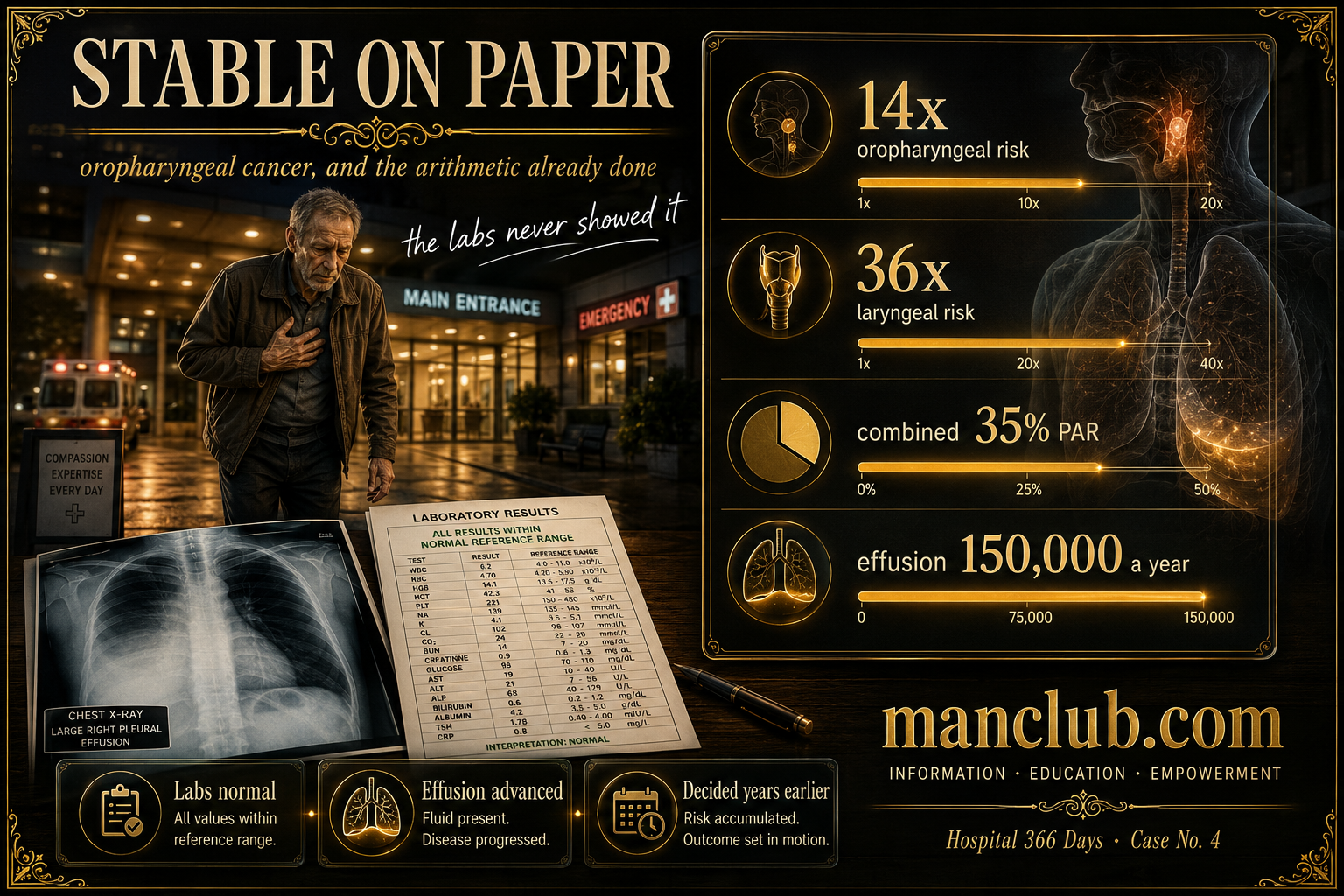
His lab values would have looked reassuring. Lactic acid 1.9. CK 184. Glucose 98. CBC within normal limits. Blood pressure 108 over 74. Heart rate 84. Oxygen saturation 96 percent on room air. On paper, he was a stable patient.
This is not the story of every man who arrives short of breath. It is a look, in numbers, at why a stable lab sheet can sit on top of advanced disease, why alcohol and tobacco together did more than either alone, and why the decisive part had already happened years before the emergency room door.
What the Numbers Did Not Say
The reality was not what the labs showed. The chest X-ray taken that day showed a large pleural effusion filling the right side of his chest.
A biopsy result from a few weeks earlier was already in his chart. Poorly differentiated malignant spindle cell neoplasm, most consistent with sarcomatoid squamous cell carcinoma. The cancer had started in the throat behind the mouth, an area called the oropharynx.
His chart listed more. Alcohol dependence with a history of withdrawal seizures. Nicotine dependence. Hepatitis C. A positive tuberculosis test. Stacking that much inside one body takes time.
The Sequence That Brought Him In
Over years: The daily drinking and smoking ran alongside hepatitis C, a positive TB test, and no fixed place to sleep. None of it announced itself on a single day.
A few weeks earlier: A biopsy was taken and read. The diagnosis was already in his chart before this visit began.
Two days before arrival: He grew short of breath. It worsened when he lay flat, the pattern of fluid in the chest.
Arrival at the emergency room: Stable vitals, reassuring labs, and a chest X-ray that told a different story than the numbers. The admitting team could clear his breathing that night.
The Hospital Did Not Miss It
This is where the case parts from the others in the series. Nothing was blocked by cost. Nothing was held back by waiting.
ENT performed the laryngoscopy, took the tissue, and the diagnosis was confirmed and posted to his chart quickly. The right specialist ran the right test. The emergency room could drain the fluid and ease his breathing. Nothing the system did was wrong or late.
And the outcome did not change. There was not much more medicine could do at that point. The decisive part was no longer something that happened inside a hospital. It had already run its course years before he pushed open the emergency room door.
The normal numbers on the lab sheet were not lying. They simply said nothing about where he had come from, or where he was going. The hospital is the last room, not the room where the decision gets made.
Plain-Language Reference
| Term | What It Means in Plain Language |
|---|---|
| Oropharynx | The part of the throat directly behind the mouth, including the base of the tongue and tonsils. |
| Oropharyngeal cancer | Cancer that starts in that part of the throat. Alcohol and tobacco are major risk factors. |
| Squamous cell carcinoma | A common cancer arising from the flat surface-lining cells of the mouth and throat. |
| Sarcomatoid variant | A rare form in which the tumor shows both squamous and spindle-shaped cells. It recurs faster. |
| Spindle cell neoplasm | A tumor made of elongated, spindle-shaped cells, seen in the sarcomatoid form. |
| Pleural effusion | Fluid built up in the space around the lungs. It makes breathing hard. |
| Malignant pleural effusion | That fluid, caused by cancer reaching the lining of the lung. It signals advanced disease. |
| Orthopnea | Shortness of breath that gets worse when lying flat. A classic sign of fluid in the chest. |
| Laryngoscopy | A scope exam of the throat and voice box, used to see and biopsy a tumor. |
| Metastatic | Cancer that has spread from where it started to other parts of the body. |
| Population attributable risk | The share of cases in a group that can be traced to a given cause. |
| Multiplicative risk | When two risks combine to more than their sum, multiplying rather than adding. |
| Hepatitis C | A viral liver infection, now curable with an 8 to 12 week oral course in most cases. |
| Tuberculosis (TB) | A respiratory infection spread through the air, rare in the general population but concentrated where risk factors stack. |
| Cancer screening | Testing that looks for cancer before symptoms appear, when treatment tends to work better. |
| Clinical Marker | This Case | Significance & Reference |
|---|---|---|
| Standard labs | Within normal limits | Lactic acid 1.9, CBC normal, O2 sat 96%. Reassuring numbers that said nothing about the disease already present. |
| Pleural effusion | Large, right side | Malignant pleural effusion signals advanced, metastatic disease. More than 150,000 U.S. cases a year (StatPearls, 2024). |
| Combined alcohol + tobacco | Both, daily, years | Roughly 14 times the oropharyngeal cancer risk and 36 times the laryngeal cancer risk of someone who does neither (NCI PDQ, 2025). |
| Sarcomatoid variant | Confirmed on biopsy | 60% had locoregional recurrence, mean overall survival 20 months in one large-center series (Otolaryngol Head Neck Surg, 2021). |
| Stacked infections | HCV + TB positive | Both concentrate in groups where homelessness and heavy substance use overlap (CDC, 2024). |
Stable on paper. The arithmetic was long since done.
From the Reviewer · Eleanor Hayes, M.D.
(A) The hardest patient is the one whose labs read fine
In cases like this, the reassuring lab sheet is the trap. Normal lactic acid, normal CBC, oxygen saturation of 96. Each line, taken by itself, looks fine, while the same chest may already hold more than a liter of fluid. A pleural effusion fills quietly and slowly. By the time breathlessness on lying flat brings someone in, the disease has usually been moving in silence for a long while. The numbers are accurate and beside the point at the same time.
(B) Alcohol and tobacco do not add, they multiply
Alcohol is its own risk. Tobacco is its own risk. What matters is what happens when both pass through the same mouth and throat. A person who smokes more than a pack a day and has more than three drinks a day carries roughly 14 times the risk of oropharyngeal cancer, and roughly 36 times the risk of laryngeal cancer, compared with someone who does neither. (NCI PDQ, 2025) A liter a day and half a pack a day are not two lines of risk placed side by side. They are one line multiplied by the other.
(C) The combination beats the multiplicative model
A pooled analysis of 17 studies found the joint effect of tobacco and alcohol exceeded what a multiplicative model predicts. Of the 72% population attributable risk for head and neck cancer, 4% was alcohol alone, 33% was tobacco alone, and 35% was the two combined. (INHANCE, Cancer Epidemiol Biomarkers Prev, 2009) That combined 35% is the largest single slice, larger than either habit on its own. That is what multiplication looks like in a population, running every day for years before anyone is looking.
(D) What sarcomatoid squamous cell carcinoma is
This is a rare variant of squamous cell carcinoma in which one tumor shows both conventional epithelial squamous cells and elongated spindle-shaped cells side by side. It accounts for roughly 1% of head and neck squamous cell carcinomas, and most patients are older men with a smoking history. It recurs faster and carries a heavier prognosis than the conventional form. In one large-center analysis, 60% of patients had locoregional recurrence, 21.8% had distant metastatic recurrence, half of those who recurred did so within 4 months, and mean overall survival was 20 months. (Otolaryngol Head Neck Surg, 2021)
(E) What the water in the chest means
The fluid has a name: malignant pleural effusion. It is the sign that cancer has reached the pleura, and at this stage it means the disease has gone advanced and metastatic. The United States sees more than 150,000 cases a year, and the most common presenting symptom is shortness of breath, in more than half of patients. (StatPearls, 2024) Two days of breathlessness while lying flat was that sign. Mean survival after diagnosis ranges from 3 to 12 months, and treatment aims at symptom relief rather than cure. The drainage helps the breathing; it does not touch the cause.
(F) The infections that stack in this profile
Hepatitis C is a viral liver infection. Roughly 2.2 to 4 million Americans are estimated to live with chronic infection, most often from shared drug-injection equipment, and new acute infections rose more than fivefold from about 11,800 in 2010 to roughly 69,800 in 2021. Direct-acting antivirals now cure more than 95% of cases in an 8 to 12 week course, but left untreated it progresses to cirrhosis and liver cancer. (CDC, Hepatitis C Surveillance) Tuberculosis is rare in the general population: 10,388 cases in 2024, about 3 per 100,000. But where risk factors stack, homelessness, incarceration history, heavy alcohol and drug use, the rate runs about ten times higher. (CDC, Reported Tuberculosis 2024)
(G) Why some countries catch this earlier
Most cancers and chronic conditions follow the same pattern: damage stacks, the person does not feel the accumulation, and by the time they come in the disease is often advanced. Some countries treat catching disease before symptoms as a national matter. Korea launched a national program in 1999 covering five cancers, and gastric cancer mortality has been reported roughly 47% lower after the rollout of endoscopic screening compared with no screening. (JCO Global Oncology, 2018) In the United States, who gets screened and when depends heavily on insurance, motivation, and access, which is exactly the axis a patient like this falls off.
(H) Where the deciding actually happens
It is worth being precise about what went right here, because the temptation is to look for a missed step. There was none. The scope was done, the biopsy read, the effusion drained. In cases like this, the system performs and the result still does not move, because the decisive stretch is upstream of the hospital entirely. It sits in the daily exposures and the missing regular care in the years before the first symptom.
(I) What an inpatient stay can and cannot do
There is an honest limit here. An inpatient stay can drain the fluid and make breathing easier. It can confirm what the disease is. It cannot rewind the years that built the body that walked in. What matters most in oropharyngeal cancer cases like this is decided long before the chest film, in how much a person is able to put into protecting his own body in an ordinary day. That a road is hard is not a reason to push a body already carrying hepatitis, tuberculosis, and a growing tumor with more alcohol and more cigarettes.
What This Costs, and Who Pays
This case turns the usual cost story on its head. Nothing here was blocked by price, and the testing was not delayed. The expensive part was not the workup. It was everything that came before it, and none of that showed up on a bill until the disease was already advanced.
| Cost Scenario | Estimated Figure | Who Carries It |
|---|---|---|
| Hepatitis C cure (oral course) | Curative, ~8 to 12 wks | Coverage varies |
| Pleural drainage + ER visit | ~$3,000 to $10,000 | Insurance / patient share |
| Cancer workup + inpatient stay | $20,000 to $50,000+ | Insurance / patient share |
| Advanced-stage cancer care | Six figures, common | Insurance / patient share |
Sources: CDC; StatPearls. Figures are broad estimates that vary widely by plan, region, and setting.
Here is the core of it. The screening and early care that might have changed this picture are relatively cheap. A hepatitis C cure is an oral course. Cancer screening at an earlier stage costs a fraction of advanced-stage treatment. The expense lands at the end, on the advanced disease, precisely because the inexpensive early steps were the ones a life on the street made hardest to reach.
Other cases in this archive turn on the same distance between years of exposure and the moment medicine finally meets it. How a serious finding surfaces during a workup aimed elsewhere runs through the case of back pain that turned out to be multiple myeloma. How a person reaches a hospital with no one beside them appears in the case of older men living alone. And a cancer whose cost fell on a different country runs through the HER2 breast cancer cost case.
Tools for Reading Your Own Numbers
A reassuring lab sheet does not tell the whole story. Three calculators that help frame blood work, longevity, and heart numbers against age-matched references.
· Blood Work Decoder (Metabolic Panel Reader)
· Life Calculator (Longevity Estimate)
· Heart Age Calculator (Cardiac Risk Estimate)
Cliff was admitted, his breathing was eased, and the diagnosis in his chart was confirmed. The emergency room settled the first question, whether the breathlessness was something it could fix that night. It was, and it did. What the visit could not settle was the disease underneath, which had gone advanced before he ever arrived.
That is the sorting a case like this leaves behind. The acute problem, the fluid in the chest, has an answer, and the answer works. The chronic story, the years of exposure and the missing early care, does not have a hospital answer at all. The two do not resolve on the same timeline, and only one of them fits inside an admission.
Earlier screening, at an earlier stage, might have changed the picture. That is not a verdict on one man. It is the part of the arithmetic that was decided long before the chest film, and it is still being decided, right now, for others standing where he stood.
Names and identifying details in this case have been altered to protect privacy. The case is a composite reconstructed from publicly reported clinical patterns and does not represent any specific patient. This content is for general information only and is not medical, legal, or psychological advice, and reading it creates no provider-patient relationship. If you or someone you know is living with an untreated chronic condition, alcohol or tobacco dependence, isolation, or housing instability, this is a sensitive area and support is available through a qualified licensed professional in your area.
Take care of yourself. Nobody else will do it for you.

Wilbur P is the editor of Manclub, leading coverage across health and life. His work is research-driven and built on primary sources a reader can verify – written for men in the second half of life who would rather know than believe. Based in Florida, still learning and still in the fight. Corrections, questions, story tips: [email protected].